
This post talks about pretend play & why it matters so much. It matters SO much, that we incorporate it into our evidence-based practices at CB Speech Therapy LLC.
Why Pretend Play Matters
Pretend play is a HUGE part of a child’s development. It supports a child’s development of vocabulary, their narrative skills, and social communication skills to name a few. Here is a quick list of pretend play ideas you can use with items in your home and words that you can focus on modeling throughout:
5 Pretend Play Ideas
1. Kitchen / Restaurant
Do not have a play kitchen? Have no fear! Your kitchen works great too. Maybe don’t use the fine china for your peace of mind’s sake. Use real snack foods you prepare for your kiddo! Let them be the chef and make a plate for you. Reverse roles too!
Model words such as “Cook,” “eat,” “hot,” “more.”
2. Doctor or Vet
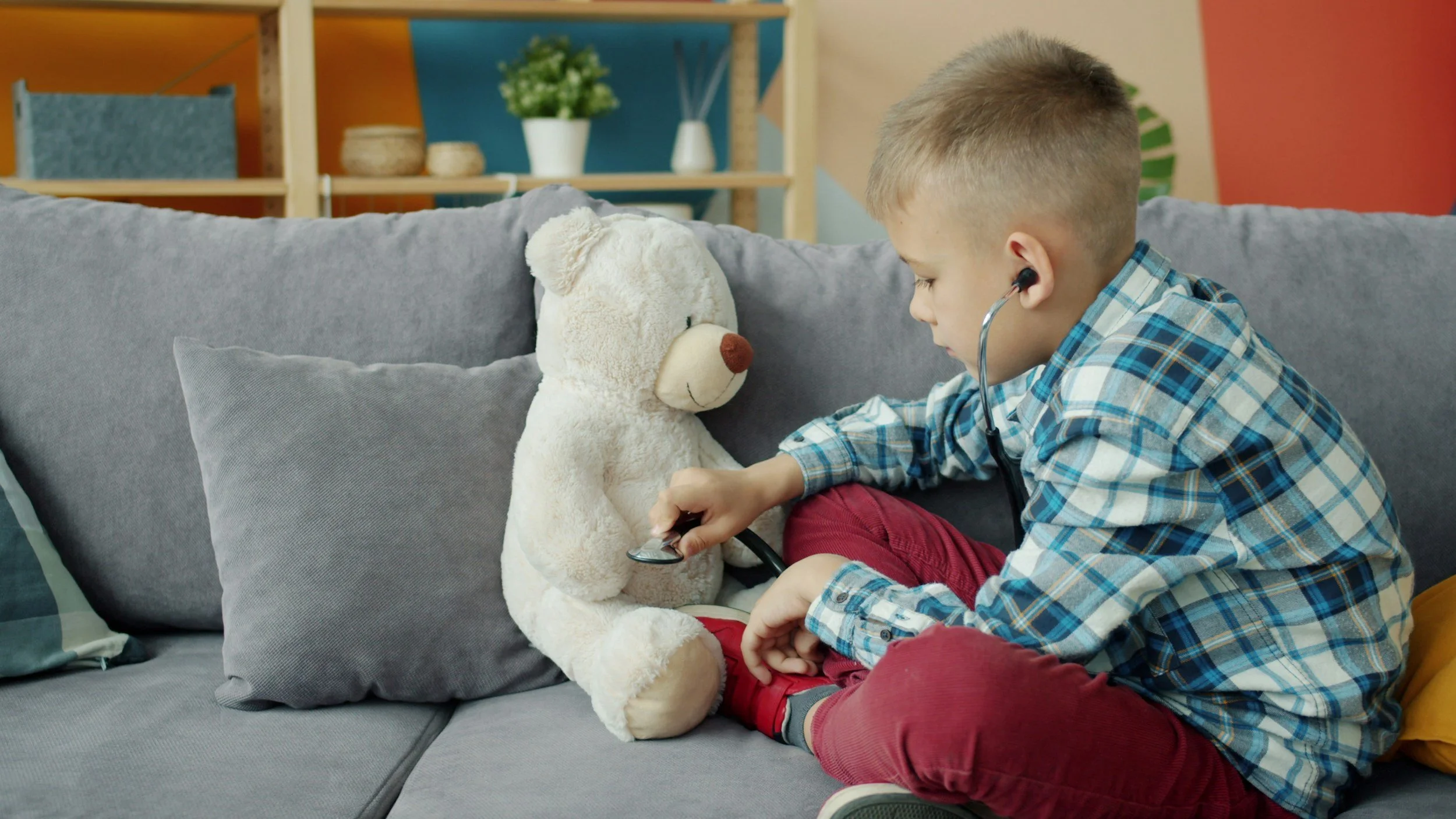
Doctor kits are great, but you can also let imaginations run wild here. Personally, I always loved playing vet more. Choose favorite stuffies or dolls, and mend all the boo-boos!
Model words like body parts, feelings/emotions, and routines (e.g., washing hands, putting on a band-aid).
3. Car Wash
Toy cars don’t have to just be in a race or crashing or flying down a ramp. Build a car wash! Maybe a toothbrush or wash cloth with a small container of soapy water. Don’t feel stuck on cars here either. Dinosaur or dolly bath time can be great as well.
Try modeling some action words: “go,” “stop,” “wash,” “dry.”
4. Dolls or Figures
Practice everyday routines and emotions. The best part about babydolls is that they do all the things you do together. Let your child be the lead. Maybe baby is hungry, needs a bath, needs a nap…the possibilities are endless.
5. Construction Site
Cue a certain someone singing about an excavator here! (IYKYK)
Use blocks and cars/trucks to get to work!
Model actions and simple phrases: “build,” “up,” “fall down.”
Bonus AAC Info
AAC fits naturally into pretend play and benefits both speaking and nonspeaking children. Model the same words aloud and on an AAC device as needed. Stick with those core words, the words that we use 80% of the time across contexts (e.g., stop, go, more, all done, etc.)
In Conclusion
Carryover supporting language at home works best when it’s fun, flexible, and pressure-free.
Need an SLP? Contact CB Speech Therapy LLC regarding in-home, pediatric speech-language therapy. Schedule a free, initial consultation today.
Additional Sources:
Westby, C. (2000). A scale for assessing development of children’s play. Play & Culture Studies.
Stagnitti, K., & Lewis, F. M. (2015). Pretend play and language development. International Journal of Speech-Language Pathology, 17, 1–10.
Lifter, K., & Bloom, L. (1989). Object play and language development. Journal of Child Language, 16, 255–272.
ASHA Practice Portal: Play-Based Interventions